


Foreign investors had finally returned to India over the summer, only for a Fed hike and oil above USD 100 to send them heading for the exit again. Yet our conviction in the market is quietly growing. In this edition, we explain why much of the weakness reflects global rather than domestic factors, weigh the rising risk of populist regulation, and ask a bigger question: why India has lagged China in innovation, and why this period of adversity could finally change that. We close with three new conviction calls representing opportunities we believe will deliver substantial value over the coming years. Enjoy!
The MSCI India Index was down 5.52% (in USD terms1) over Q3 2026, driven by a sharp selloff in September, as a renewed surge in oil prices and the US Federal Reserve’s first rate hike since 2023 overwhelmed a resilient domestic growth backdrop. Sector-wise, IT and Real Estate were the only sectors to post positive returns during the quarter, while Consumer Staples and Utilities were the worst-performing sectors. Foreign portfolio investors (FPIs) were net buyers of Indian equities over the quarter, purchasing approximately USD 1.5 billion, the first quarterly net inflow since Q2 2025. But that figure masks a sharp reversal within the quarter: inflows of USD 5.2 billion in July and August gave way to net selling in September, which reversed ~USD 3.7 billion of the flows.2 Cumulative 2026 outflows stood at roughly USD 28 billion at quarter-end, already the heaviest for any calendar year on record.3
Gains built in July and August were undone in September, as three forces reversed the earlier rotation out of global AI hardware names and into Indian IT services. First, the Fed raised the federal funds rate by 25 basis points to 3.75% to 4.00% on September 16, citing elevated inflation. Higher US rates and rising global bond yields weighed on emerging market flows, and Indian IT, with its heavy exposure to US client spending, gave back its July rally. Second, the US-Iran conflict kept oil elevated throughout the quarter, with the Reserve Bank of India (RBI) intervening to hold the rupee below 96 per dollar. Third, on September 23, the Insurance Regulatory and Development Authority of India (IRDAI) released a draft paper on insurance distribution economics proposing commission caps. The paper triggered sharp falls across insurers, distributors, and banks reliant on insurance fee income. A heavy IPO pipeline, headlined by the National Stock Exchange’s own listing, also drew liquidity away from the secondary market.
On the macro front, growth remained the bright spot. Real GDP grew 7.8% y/y in the June quarter (Q1 FY27), above the RBI’s 7% projection, led by a double-digit rise in fixed investment.4 Inflation, however, moved steadily higher. Headline consumer price index (CPI) inflation climbed from 4.38% in June to 5.54% in September, as food inflation accelerated to 7.74%, the highest since October 2024.5 After holding the repo rate at 5.25% in August, the RBI raised it by 25 basis points to 5.50% on October 7 and shifted its stance from neutral to calibrated tightening, its first hike since February 2023.
The manufacturing purchasing managers’ index (PMI) rebounded to a seven-month high of 55.1 in September, though its quarterly average was the lowest since 2021; services activity followed a similar pattern, with the quarterly average the weakest in more than four years.6 Consumption held firm, with gross Goods and Services Tax (GST) collections up 14.7% y/y to approximately INR 2.04 trillion (~USD 21 billion) in September, a third consecutive month above INR 2 trillion.7 Foreign exchange reserves reached a record USD 785.7 billion in early September on inflows from the RBI’s special FCNR(B) deposit window, giving the central bank a buffer as it defended the rupee in late September.
India has had a difficult year. As of 9 October, foreign investors have withdrawn over USD 30 billion from Indian equities YTD this year, and the third quarter brought a fresh set of pressures, from higher global yields and oil prices to a wave of regulatory intervention at home.8 Yet our conviction in the market is quietly growing. Below, we set out the global backdrop, why we remain constructive on India despite it, the domestic risks we are watching, and why we think this period of adversity could ultimately leave India stronger.
The global macro backdrop was the main overhang over the quarter. In the US, bond yields have moved higher as the economy runs hot, with nominal GDP growing at an annualized 8.5% in the second quarter, and higher oil prices have compounded the pressure. If yields remain sticky, the pain will flow through to smaller businesses and weaker balance sheets, and we would expect some of the weaker dominoes to fall. Credit spreads are already widening in the weaker parts of the market, and refinancing will become harder for highly indebted companies and economies.
It is still early, however, and earnings growth remains strong. We think widespread defaults are unlikely, as governments have repeatedly shown they will step in, and for the strongest companies any downturn should prove temporary. Policy also offers a backstop. The Fed’s balance sheet matters more than its rhetoric, and if yields rise too far, we would expect the response to move beyond verbal reassurances.
Oil remains the other key overhang, as the stalemate in the Middle East has lasted far longer than anyone envisioned. The world has so far avoided the worst of the pain by drawing down inventories, but that buffer is wearing thin heading into winter. Our sense is that Iran may be content to hold out until after the US midterms rather than hand the administration a victory beforehand. The pressure, however, is increasingly building on Iran. Gulf producers have rerouted a growing share of their exports around the Strait of Hormuz, with around 40% now bypassing it by pipeline.9 The US has also recently eased sanctions on Russian diesel, further weakening Iran’s leverage.10 Our hope is that a resolution can be found after the midterms.
For India, these global pressures arrived together in September. A Fed hike and rising yields drew foreign capital away from emerging markets, while oil above USD 100 per barrel weighed on the rupee and contributed to the RBI’s first rate hike in more than three years. The oil shock also has a feature that headline crude prices miss. Because India regulates retail fuel prices, a squeeze in global diesel markets shows up as shortages rather than as inflation at the pump: supply strain on the ground, and losses that either the oil marketing companies or the government must absorb. The clearer winners are export-oriented refiners, which benefit from widening product spreads. The pressure is also working through corporate cost bases. Our channel checks point to some industrial inputs rising by more than 50% in a short period, and companies are finding these increases hard to pass on. Last quarter’s results were flattered by inventory gains, so we expect softer guidance in the October results season.
Where we take a less conventional view is in how little it may take for global equity markets to turn. Gains this year have been narrow and driven largely by tech, while much of the rest of the market has lagged and sentiment toward it remains subdued. Recent US payroll data have softened, easing pressure on the Fed to keep raising rates, and conciliatory statements from Iran suggest the worst outcomes in the Middle East may be behind us. If these concerns ease, bond yields could fall back below 5% and, with oil easing, equities could rally strongly. With little exposure to the AI hardware trade, India has been among the markets left behind this year. Given how light foreign positioning has become, it would be well placed to benefit.
Despite the downturn we’ve seen in India, our conviction in the market is quietly growing. Much of the weakness reflects global factors rather than domestic fundamentals. The economy has delivered two quarters of strong growth with healthy business creation, and the trade deals India has signed reinforce its position as the leading China+1 destination.
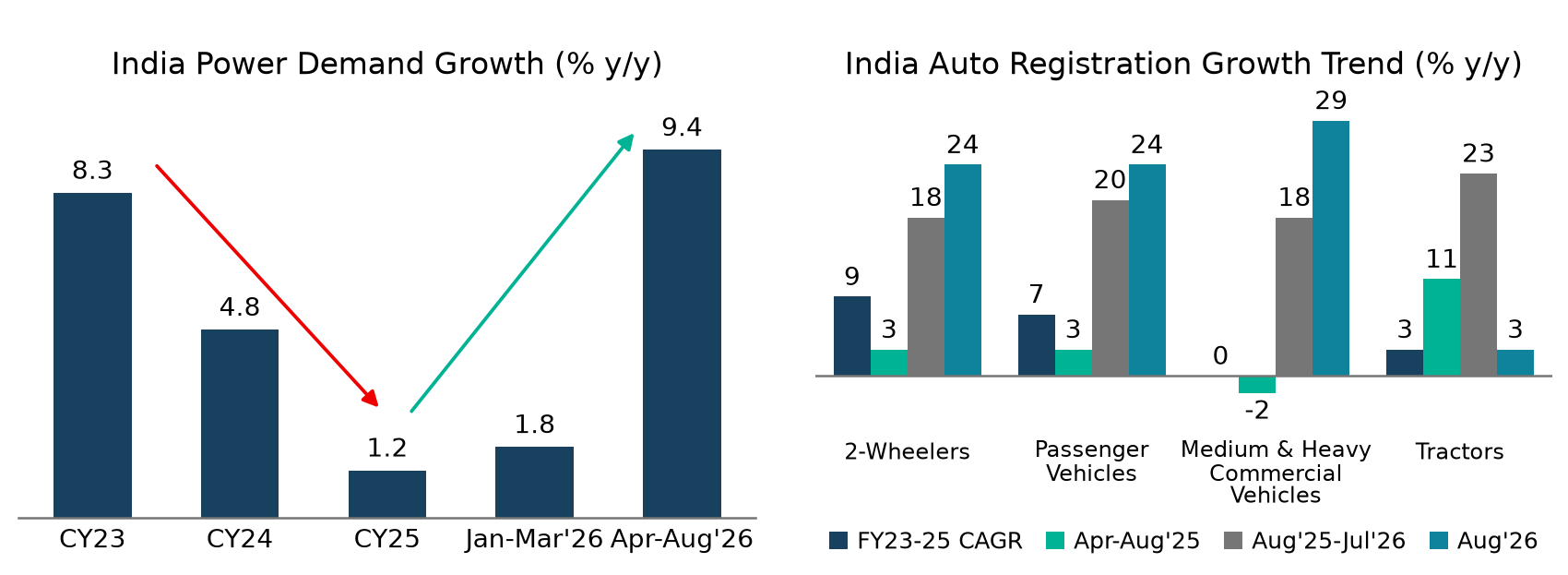
Domestic investors remain a powerful source of support. Monthly systematic investment plan (SIP) contributions reached a record high of roughly INR 325 billion (~USD 3.4 billion) in September, even as foreign investors sold.11 That steady domestic bid has cushioned the market through a year of heavy foreign selling, and it shows how far the ownership base of Indian equities has shifted.
What we think the market underappreciates is how much less sensitive India has become to oil. Oil consumption relative to GDP has halved over the past decade, helped by solar-powered irrigation, expanding metro networks, greater use of renewables by industry, and a growing shift to electric vehicles. Crude imports have fallen from a peak of 8.6% of GDP in 2013 to around 3% last year.12 Should tensions in the Middle East ease, lower oil prices would be a strong tailwind for India.
Conviction does not mean complacency, and the risk we debated most within our team this quarter was closer to home: a rise in regulatory intervention. There were three cases, in particular, that came in succession.
In insurance, the regulator released a draft paper on insurance distribution economics on September 23, proposing commission cuts of 50% to 60% across life, health, and general insurance, with the stated aim of improving affordability and curbing mis-selling. Distribution platforms were hit hardest. The bull case is that online specialists gain share as banks and lenders (for whom insurance is a side business) deprioritize it. The bear case is that share gains will not offset a shrinking profit pool. The market expects the final rules to be watered down, but the uncertainty is real. Within the portfolio, our exposure to the most affected business models is limited.
In hospitals, India’s Supreme Court asked the government to investigate allegations that hospitals push patients to buy medicines from in-house pharmacies at steep mark-ups, and questioned whether a uniform 16% margin should apply to all medicines. This triggered a sector selloff at the end of September. By our estimates, pharmacy accounts for roughly 20% to 25% of hospital revenue and around 30% of EBITDA, so the stakes are meaningful.13 One view within the team is that the selloff was an overreaction. The sector’s structure makes blanket regulation difficult, and past interventions have targeted specific sets of drugs rather than the sector as a whole.
Payments offered a rare regulatory positive, at least for the companies that process them. UPI, India’s real-time payments system, has been free for merchants for more than six years, so banks and payment apps have earned nothing for handling the bulk of the country’s digital transactions. Following the Diwali festival in November, merchants will pay a fee of 0.4% on each UPI payment above INR 2,000 (~USD 21), capped at INR 300 (~USD 3) per transaction, while smaller payments remain free.14 This creates a profit pool for the industry for the first time, though we expect competition to intensify as players fight for it.
Our broader takeaway is that these risks should not be shrugged off. Fiscally constrained governments tend to turn populist. When they cannot spend their way to job creation, they reach for the levers they can pull, and price controls in consumer-facing sectors are among the easiest. We have seen this elsewhere in the region, as in Indonesia, where ride-hailing platforms were pushed to cut the commissions they take from drivers. This is a different environment from five years ago, and it argues for favoring the strongest operators: those with the scale, balance sheets, and diversified revenue to absorb a hit to any single profit pool.
Another recent debate within our team looked further ahead, at one of the bigger questions about India’s long-term growth: why it has not produced the kind of innovation that we’ve seen out of China. The debate was prompted by a single deal. In late September, Merck agreed to pay up to USD 2.13 billion, including USD 400 million upfront, to China’s SciBrunch Therapeutics for an experimental cancer drug that is still in preclinical development.15 SciBrunch is barely two years old and was founded by alumni of WuXi AppTec, which shows how deep China’s biotech ecosystem has become. But this isn’t an isolated case. By our estimates, upfront payments from Chinese biotech licensing deals over the past six months alone exceeded the net income of India’s entire domestic pharma sector.16
The contrast is striking because the roles have reversed. A decade ago, we would sit with Chinese pharma management teams and walk them through how Sun Pharma and Lupin had built their franchises, as a roadmap to the valuations Indian companies then enjoyed. Today, the lesson runs the other way. Indian IT services companies face a similar criticism. For years, the large IT companies traded at >25 times earnings, with ample cash and highly valued equity, yet made few bold bets on research or on seeding new ventures.
Within our team, the explanations ranged from a cautious, risk-averse corporate mindset to the role of policy in shaping each country’s ecosystem. Perhaps the most compelling was that the past decade was simply too good for India. Markets kept rewarding the status quo, so there was little reason to change what was working. China, by contrast, was forced to reinvent itself through trade wars, COVID-19, and a property crisis, and emerged with global leaders such as CATL and BYD.
That is why we see the current period as an opportunity. As we’ve written in the past, adversity is often what forces economies and companies to sharpen their competitiveness. AI is the most direct challenge yet to the labor-cost advantage that served Indian IT services so well, and it will force companies across the economy to rethink how they work. As AI moves from the build-out phase toward broad adoption over the next few years, we expect the benefits to flow increasingly to AI adopters. With a younger generation of founders showing a far greater appetite for risk, and incumbents now pushed to adapt, we believe India will not let this downturn go to waste, but will embrace the challenge and use AI to raise its game.
September was a difficult month for Indian equities, and markets have remained volatile into October. We see this as an opportunity rather than a warning. Concerns over oil, US rates, and foreign outflows are now largely in the price, while domestic demand and domestic flows remain firm. Near term, we expect earnings guidance to soften as input costs bite. Even so, with valuations reset and foreign positioning light, the hurdle for a positive surprise is lower than it has been for some time. The upcoming Q2 FY27 results season will be an important test.
Within the portfolio, we hold a mix of large and small/mid-caps across sectors. While we are seeing signs of excessive valuations in small caps, we have been disciplined in the companies and management teams we back, many of which we have known for more than 5 years. Where we are buying into well-owned names that are not cheap, the question we ask is what it will take for the business to scale, and whether it will hit a wall along the way. Management commentary alone is not enough, so we test each story against global precedents. For example, in consumer internet, we compare Meesho with the paths taken by Amazon and PDD, and Eternal (Zomato) with Alibaba and Meituan. In manufactured exports, we look at how Chinese exporters ramped up before them.
We would describe ourselves as cautiously bullish, which for us means having thought through what could go wrong and preparing for multiple scenarios. What we hold is a portfolio we believe is resilient: built around strong operators and idiosyncratic stories with their own catalysts, and positioned to look through near-term dislocations rather than be driven by them.
Each quarter, we highlight a select number of companies that showcase exceptional growth potential. These stocks on our conviction list represent opportunities we believe will deliver substantial value over the coming years. This quarter, we feature three companies we added during Q3.
| Stock | Investment Rationale |
|---|---|
| Poonawalla Fincorp | Poonawalla is a non-bank lender focused on consumer and small business loans. We see it as a mini Bajaj Finance in the making. Led by executives from HDFC Bank and other leading retail lenders, it has been rebuilt as a digital-first lender, with no legacy processes to unwind. AUM grew 62.5% y/y to INR 670.54 billion (~USD 7.1 billion) in Q1 FY27, with asset quality improving, and management is targeting 35-40% annual AUM growth over the next few years.17 With India’s largest lenders constrained by already high market share, we see Poonawalla as a high-conviction way to capture the next leg of retail credit growth. |
| Meesho | Meesho is a value-focused e-commerce marketplace connecting small sellers with price-conscious shoppers, mostly in India’s smaller cities and towns. Built largely over the past five to seven years, it is our purest play on tier-2 and tier-3 India, processing nearly 725 million orders in Q1 FY27.18 Its key strength is a deep vendor base, whose breadth of low-cost assortment draws shoppers and, in turn, more sellers, creating strong economies of scale. Monetization is still early, but contribution margin rose to 4.6% of net merchandise value, and we expect advertising and seller services to gradually monetize the platform, much as PDD did in China. |
| Syrma SGS Technology | Syrma SGS is an Indian electronics manufacturing services (EMS) and design company that builds electronics for customers in the industrial, automotive, healthcare, railway, and defense markets. India is working to build an indigenous electronics supply chain, and as companies that once relied on imported electronics turn increasingly to Indian contract manufacturers, established players with design capabilities stand to benefit most. Syrma serves more than 270 customers across over 20 countries, and it has a track record of managing working capital carefully, an important differentiator in a capital-intensive business. Its order book stood at INR 67 billion in June 2026, up 23% from a year earlier, with growing contributions from defense and railways.19 |
For sophisticated investors only. For informational purposes only. The information presented in the material is not, and may not be relied on in any manner as legal, tax, investment, accounting or other advice or as an offer to sell or a solicitation of an offer to buy an interest in any investment product or any other entity sponsored or managed by Shikhara Investment Management. This material doesn’t constitute and should not be considered as any form of financial opinion or recommendation.
This material is prepared by Shikhara Investment Management LP (“Shikhara”). This material does not constitute an offer to sell or the solicitation of an offer to buy in any state of the United States or other U.S. or non-U.S. jurisdiction to any person to whom it is unlawful to make such offer or solicitation in such state or jurisdiction.
Investment involves risk. Past performance is not indicative of future performance. It cannot be guaranteed that the performance of the investment product will generate a return and there may be circumstances where no return is generated. Investors could lose all or a substantial portion of any investment made. Before making any investment decision, investors should read the Prospectus for details and the risk factors. Investors should ensure they fully understand the risks associated with the investment product and should also consider their own investment objective and risk tolerance level. Investors are advised to seek independent professional advice before making any investment.
Shikhara’s investment products are suitable only for sophisticated investors and require the financial ability and willingness to accept the high risks and lack of liquidity inherent in Shikhara’s investment products. Prospective investors must be prepared to bear such risks for an indefinite period of time. No assurance can be given that the investment objectives of any given investment product will be achieved or that investors will receive a return of their investment.
Certain of the information contained in this material are statements of future expectations and other forward-looking statements. Views, opinions and estimates may change without notice and are based on a number of assumptions which may or may not eventuate or prove to be accurate. Actual results, performance or events may differ materially from those in such statements.
Certain information contained in this material is compiled from third-party sources. Whereas Shikhara has, to the best of its endeavor, ensured that such, information is accurate, complete and up-to-date, and has taken care in accurately reproducing the information, Shikhara takes no responsibility for the accidental publication of incorrect information, nor for investment decisions taken based on this material. Neither Shikhara nor any of its affiliates makes any representation or warranty, express or implied, as to the accuracy or completeness of the information contained herein, and nothing contained herein should be relied upon as a promise or representation as to past or future performance of any investment product or any other entity.
The contents of this material are prepared and maintained by Shikhara and has not been reviewed by the Securities and Exchange Commission of the United States.
The Fund managed by Shikhara may or may not hold all of, or some of the securities mentioned in the article.
The Shikhara logo and name are trademarks of Shikhara Investment Management LP, registered in Hong Kong, the People’s Republic of China (PRC), Australia, the United Kingdom, the European Union, and the United States.

This website is published exclusively for the purpose of providing general information about the management services carried out by Shikhara Investment Management LP, Shikhara Capital (Hong Kong) Private Limited and its affiliates (collectively “Shikhara Investment Management” or “Shikhara”). The information presented on the website is not, and may not be relied on in any manner as legal, tax, investment, accounting, or other advice or as an offer to sell or a solicitation of an offer to buy an interest in any investment product or any other entity sponsored or managed by Shikhara Investment Management. This website doesn’t constitute and should not be considered as any form of financial opinion or recommendation.
Shikhara Investment Management LP is a Registered Investment Adviser with the U.S. Securities and Exchange Commission, and Shikhara Capital (Hong Kong) Private Limited is licensed by the Hong Kong Securities and Futures Commission. This website does not constitute an offer to sell or the solicitation of an offer to buy in any state of the United States or other U.S. or non-U.S. jurisdiction to any person to whom it is unlawful to make such offer or solicitation in such state or jurisdiction.
Investment involves risk. Past performance is not indicative of future performance. It cannot be guaranteed that the performance of the investment product will generate a return and there may be circumstances where no return is generated. Investors could lose all or a substantial portion of any investment made. Before making any investment decision, investors should read the Prospectus for details and the risk factors. Investors should ensure they fully understand the risks associated with the investment product and should also consider their own investment objective and risk tolerance level. Investors are advised to seek independent professional advice before making any investment.
Shikhara’s investment products are suitable only for sophisticated investors and require the financial ability and willingness to accept the high risks and lack of liquidity inherent in Shikhara’s investment products. Prospective investors must be prepared to bear such risks for an indefinite period of time. No assurance can be given that the investment objectives of any given investment product will be achieved or that investors will receive a return of their investment.
Certain of the information contained in this website are statements of future expectations and other forward-looking statements. Views, opinions, and estimates may change without notice and are based on a number of assumptions which may or may not eventuate or prove to be accurate. Actual results, performance, or events may differ materially from those in such statements.
Certain information contained in this website is compiled from third-party sources. Whereas Shikhara Investment Management has, to the best of its endeavor, ensured that such information is accurate, complete, and up-to-date, and has taken care in accurately reproducing the information, Shikhara Investment Management takes no responsibility for the accidental publication of incorrect information, nor for investment decisions taken based on this website. Neither Shikhara Investment Management nor any of its affiliates makes any representation or warranty, express or implied, as to the accuracy or completeness of the information contained herein, and nothing contained herein should be relied upon as a promise or representation as to past or future performance of any investment product or any other entity.
The contents of this website are prepared and maintained by Shikhara Investment Management and has not been reviewed by the Securities and Exchange Commission of the United States or the Securities and Futures Commission of Hong Kong.
The Shikhara logo and name are trademarks of Shikhara Investment Management LP, registered in Hong Kong, the People’s Republic of China (PRC), Australia, the United Kingdom, the European Union, and the United States.