


The near term appears quiet for India – a benchmark that was flat in August, and a market we expect to trade in a range until investors gain comfort on how the AI transition lands for the country. But quiet is not idle. We argue that a breather in AI spending is a welcome reprieve for an adopter economy like India’s, one that buys time to adapt. The real opportunity sits beneath the index: in the rotation from “old” to “new-age” India, and in manufacturing-export share gainers, healthcare, and cash-generative franchises.
The MSCI India Index returned -0.30% (in USD terms1) in August, a broadly flat headline that masked a two-speed market: large-cap defensives bore the brunt of the month’s selling while cyclicals and the broader market held firm. By sector, Industrials led, followed by Materials and Consumer Discretionary, while Utilities, Consumer Staples, and Communication Services were the principal laggards. Foreign portfolio investors (FPIs) remained net buyers of Indian equities for a second consecutive month, purchasing ~USD 3.1 billion, their strongest monthly inflow since September 2024, reducing the cumulative 2026 outflows of roughly USD 24 billion.2
The month reflected the pull in multiple directions from strong domestic data, higher oil prices, and changing expectations for US interest rates. Solid economic activity at home, strong FPI data, and steady buying from domestic institutions supported industrial and cyclical stocks, as well as the broader market of mid- and small-cap companies. Defensive sectors, such as consumer staples and utilities, lagged, as did sectors most sensitive to oil and interest rates. The move out of AI hardware stocks that shaped July carried over, and strong quarterly results from a major US chipmaker late in the month gave Indian IT a lift. But pulling the other way, oil prices stayed high and volatile as tensions in the Middle East flared, and the US Federal Reserve struck a firmer tone at its Jackson Hole symposium, leading investors to scale back their expectations for rate cuts.
On the macro front, the standout was a stronger-than-expected June-quarter (Q1 FY27) GDP print released at month-end: real GDP grew 7.8% y/y, above the Reserve Bank of India’s (RBI) 7% projection, led by a double-digit rise in fixed investment. Headline consumer price index (CPI) inflation edged up to 4.45% y/y in July (vs 4.38% in June), a second consecutive month above the 4% midpoint of the RBI’s target band, on firmer food prices. At its early-August meeting, the RBI’s Monetary Policy Committee held the repo rate at 5.25% for a fourth straight meeting, retained a neutral stance, and raised its FY27 growth forecast.
India’s external buffers have also strengthened: the RBI’s special Foreign Currency Non-Resident (Bank) (FCNR(B)) deposit window, opened in June to attract foreign-currency savings from non-resident Indians, drew close to USD 130 billion by the end of August, lifting foreign exchange reserves to a fresh record above USD 740 billion and materially bolstering the central bank’s capacity to steady the rupee through a volatile period for oil and global rates.3 The scale of the response led the RBI to close the window ahead of its original end-September deadline.
Business surveys diverged: the manufacturing purchasing managers’ index (PMI) eased to 52.8, its weakest reading in five years, while the services PMI firmed to 54.1.4 Consumption held up, with gross Goods and Services Tax (GST) collections rising 14.8% y/y to approximately INR 2.0 trillion (~USD 21 billion), the highest for any August to date, though net collections grew more modestly on a sharp rise in refunds.5
First, a word on where we stand on AI. We are not skeptical about AI itself. Compute demand is strong, real adoption continues to build, and corporates are adopting because the benefits to their own franchises are increasingly clear. What we remain skeptical about is how much unspent capex is already embedded in current prices, and how the regulatory framework around AI will evolve.
Our concern, which we develop in full in our Asia commentary, runs along three lines:
For India, the question takes a different lens. India is overwhelmingly an adopter of AI rather than a builder of it, and whether it ends up on the right side of the disruption is, in our view, the single most important factor for a durable return of foreign capital. The fear that keeps investors cautious is the opposite outcome: that AI erodes the formal-sector, white-collar employment base India has spent two decades building. The surface evidence is not reassuring, with financial services and IT firms slow to hire, and it sits atop the youth unemployment problem we wrote about last month.
Which is why we think a potential breather in AI capex, far from being a worry, is welcome for India. When a genuinely new technology arrives, the operators who ultimately win are the ones given time to absorb it, rebuild their processes around it, and turn it into a durable edge. A slower cycle buys that time: for the government to put its house in order on jobs and the external position before the disruption fully lands, for businesses to prepare, and for India’s AI adopters to convert the technology into productivity and share gains.
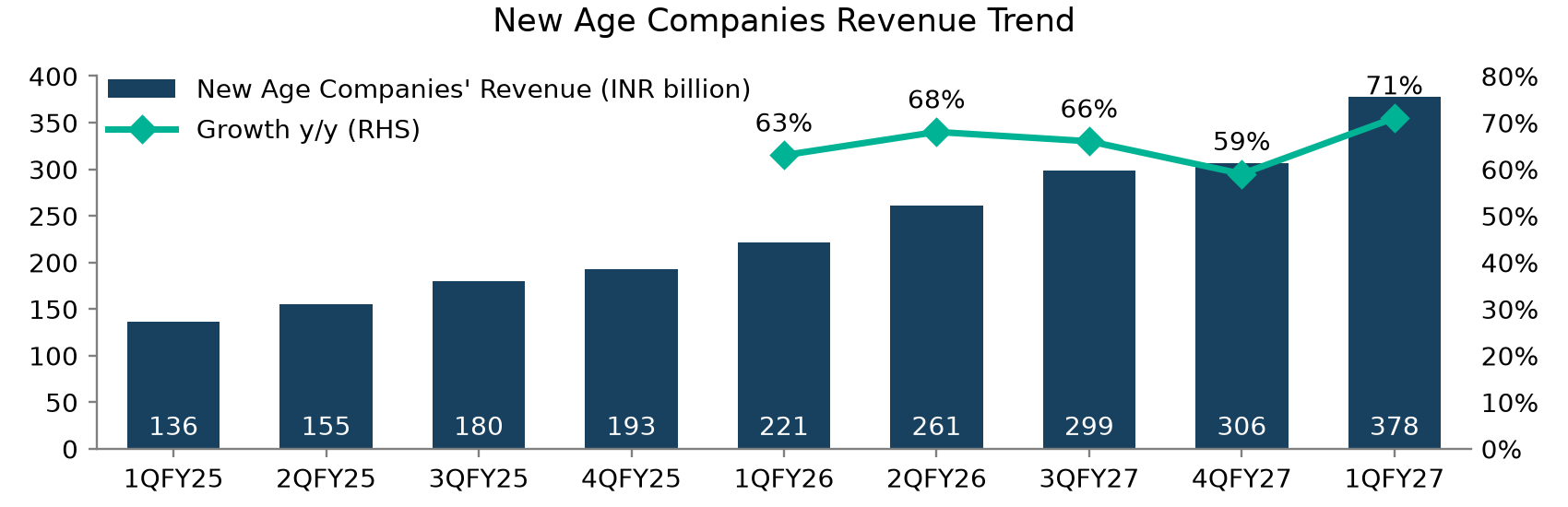
Beneath the index, an important transition is underway, and it is easy to misread the YTD foreign selling as a simple verdict on the country. What is actually happening is a rotation out of “old India” and into “new-age India”. The older listed consumer names, many of them public for a decade or more, are growing more slowly than the market, and the established staples in particular are losing share to a newer generation of competitors. Their weak earnings are not merely the product of selling pressure; they reflect genuine share loss. At the same time, foreign investors have been active buyers of the new-age consumer internet, fintech, and niche manufacturing businesses, often through IPOs and block trades. The large negative headline flow numbers and the appetite for new listings are two sides of the same coin.
We take two things from this. The first is that India’s large caps may face a time correction, with the headline index potentially moving within a fairly narrow band for the next two to three years while the real action plays out beneath the surface, where mid- and small-cap earnings and upgrades have been running well ahead. The second is a matter of discipline: consumer tastes are changing, and the listed champions of the last cycle are not automatically the champions of the next. We see a strikingly similar dynamic in China, where the unlisted players like Douyin have been gaining ground on the established e-commerce platforms. In both cases, the common thread is that consumer tastes are changing, and the listed champions of the last cycle are not automatically the champions of the next. A good deal of our research effort is spent trying to establish where the new growth is accruing, and which of the new-age companies are capturing it. On that score, our own book points to where we think the consumer is heading: Eternal (Zomato) in food delivery and quick commerce, FSN E-Commerce (Nykaa) in beauty and personal care, and Le Travenues Technology (Ixigo) in online travel, franchises we have owned for several years and that are taking share precisely because that is where spending is migrating.
Outside of consumption, our main thematic conviction is the manufacturing-export story, where India is winning genuine share as global supply chains diversify. We think this is a multi-year structural theme rather than a trade; the closest analogy we can draw is the Indian consumer sector between 2012 and 2019, a six-to-seven-year bull market, though we would acknowledge that some of these names have already moved over the past 12 to 18 months. The most interesting hunting ground within it is a set of midcaps opening up entirely new segments, in areas such as aerospace and defense, that can also lean on exports as a fresh source of growth. Sansera Engineering is one such name, a precision-components maker extending from autos into aerospace and defense.
Around that core sit a few long-held convictions. Healthcare remains a favorite of ours, spanning hospital operators and select pharmaceutical manufacturers, where demand is durable and pricing power is real. Large-cap financials are our preferred route into domestic growth, with the balance-sheet strength to compound through a tighter liquidity environment. And a small group of consumer internet platforms, which we regard as the clearest domestic adopters of AI, should widen their lead as they put their scale and proprietary data to work.
Underpinning all of it are two principles that matter more than usual right now. The first is that when money is no longer free, cash generation is prized: businesses that fund themselves and return capital to shareholders should be rewarded, while those that lean on repeated equity raises should see their multiples compress. The second is that volatility is likely to stay structurally higher than investors have grown used to, and the only reliable answer is deliberate diversification, across themes and across individual positions, so that no single shock in the technology cycle carries the whole portfolio with it.
We are also watching developments in the Middle East closely. The conflict has so far unfolded against a backdrop of inventory drawdowns, which initially helped absorb disruptions while oil prices remained relatively contained. With inventories now lower and the Northern Hemisphere winter approaching, any further disruption to supply could produce a sharper response in crude prices and place greater pressure on the parties involved to find a resolution. The path and timing remain uncertain, particularly given the political calendar, and markets may experience further near-term weakness as events develop. We would view a conflict-driven pullback as a potential opportunity to add selectively to high-conviction businesses where the underlying investment case remains intact.
We would not expect the headline index to do a great deal in the near term. Our base case is a market that trades within a plus or minus 10% band until investors gain comfort that this earnings cycle can broaden and sustain, and that India is landing on the right side of the AI transition. A re-rating from here rests on three things coming together: earnings that prove durable rather than merely strong, that evidence on AI, and a government that chooses growth and reform over the easier path of populism.
But beyond the near term, the case for India is still a structural one. The starting point is that Asia, India included, is no longer the asset class it was a decade ago, yet most global portfolios are still built as though it were. The United States now accounts for roughly 64% of the MSCI All Country World Index while producing around a quarter of global output, and the index’s ten largest companies, all but one of them American, make up close to a quarter of the whole.6
For much of the past decade, that concentration served investors well as asset-light American platforms dominated global commerce and advertising. But benchmarks are backward-looking by construction, and we would rather position for where the index is going than for where it has been. The defining demands of the next two to three decades, building out AI infrastructure, reindustrializing supply chains, electrifying transport, and hardening power grids, are physical, capital-intensive, and disproportionately met by Asia. India is a growing part of that answer, through its gains in manufactured exports and its own emerging industrial and data-center build-out.
The balance sheets tell the sharpest version of the story, and they are moving in opposite directions. The West is financing its ambitions with borrowed money: US federal debt has climbed from around 96% of GDP in 2010 to roughly 124% today and is on a path toward 142% by 2031, advanced-economy government debt is now close to 110% of GDP, and corporates are levering up to fund the AI build-out on top of that.7 The developed world, in other words, increasingly resembles the emerging markets of twenty-five years ago, when high deficits and heavy debt were the standard critique of EM.
In contrast, Asia has spent the past decade going the other way. Free cash flow across Asia-Pacific ex-Japan is heading toward a record of roughly USD 1.4 trillion, and the region’s net debt to equity is set to fall from around 18% in 2023 to below zero by 2027.8 The market has yet to reflect this, with the region yielding about 6.4% on free cash flow against 3.3% for the developed world.9 India is the one place we would temper the cheapness argument, since it screens richer than its regional peers. But even India offers a higher free-cash-flow yield than the S&P500.
Just as important, that cash is increasingly reaching shareholders as a matter of policy rather than management whim. Governance and listing standards have tightened across the region, and the reforms feed on one another: Japan’s push on companies trading below book value set a template that Korea’s Value Up program has followed, while Shanghai, Hong Kong, and India have all tightened their own standards.⁵ Once one major exchange raises the bar, the others face pressure to match it or risk losing capital to their neighbors, and that dynamic is turning capital returns into a durable feature of the region rather than a periodic gesture. India sits squarely within that shift. Aggregate dividends from listed companies reached a record of around INR 5 trillion in FY25, up roughly 11% on the prior year, and rose again in absolute terms in FY26.10
None of this requires a dramatic catalyst. We have not yet seen capital allocated to emerging markets in meaningful size, but as developed-market yields tighten and the reflation runs its course, we think the flows will follow, moving out of the developed economies where financial repression bites first and toward regions with stable regimes and fewer structural imbalances. India will participate in that rotation, though we would stress that, for India specifically, the durable return of foreign capital is gated on the very question we opened with: whether the country lands on the right side of the AI transition. That is the bridge between the near term and the long. For all the near-term caution, the medium-term opportunity beneath the index is, to our minds, the most interesting it has been in some time. We would rather spend the current lull building conviction in those businesses at sensible prices than chase an index we expect to tread water for some time.
For sophisticated investors only. For informational purposes only. The information presented in the material is not, and may not be relied on in any manner as legal, tax, investment, accounting or other advice or as an offer to sell or a solicitation of an offer to buy an interest in any investment product or any other entity sponsored or managed by Shikhara Investment Management. This material doesn’t constitute and should not be considered as any form of financial opinion or recommendation.
This material is prepared by Shikhara Investment Management LP (“Shikhara”). This material does not constitute an offer to sell or the solicitation of an offer to buy in any state of the United States or other U.S. or non-U.S. jurisdiction to any person to whom it is unlawful to make such offer or solicitation in such state or jurisdiction.
Investment involves risk. Past performance is not indicative of future performance. It cannot be guaranteed that the performance of the investment product will generate a return and there may be circumstances where no return is generated. Investors could lose all or a substantial portion of any investment made. Before making any investment decision, investors should read the Prospectus for details and the risk factors. Investors should ensure they fully understand the risks associated with the investment product and should also consider their own investment objective and risk tolerance level. Investors are advised to seek independent professional advice before making any investment.
Shikhara’s investment products are suitable only for sophisticated investors and require the financial ability and willingness to accept the high risks and lack of liquidity inherent in Shikhara’s investment products. Prospective investors must be prepared to bear such risks for an indefinite period of time. No assurance can be given that the investment objectives of any given investment product will be achieved or that investors will receive a return of their investment.
Certain of the information contained in this material are statements of future expectations and other forward-looking statements. Views, opinions and estimates may change without notice and are based on a number of assumptions which may or may not eventuate or prove to be accurate. Actual results, performance or events may differ materially from those in such statements.
Certain information contained in this material is compiled from third-party sources. Whereas Shikhara has, to the best of its endeavor, ensured that such, information is accurate, complete and up-to-date, and has taken care in accurately reproducing the information, Shikhara takes no responsibility for the accidental publication of incorrect information, nor for investment decisions taken based on this material. Neither Shikhara nor any of its affiliates makes any representation or warranty, express or implied, as to the accuracy or completeness of the information contained herein, and nothing contained herein should be relied upon as a promise or representation as to past or future performance of any investment product or any other entity.
The contents of this material are prepared and maintained by Shikhara and has not been reviewed by the Securities and Exchange Commission of the United States.
The Fund managed by Shikhara may or may not hold all of, or some of the securities mentioned in the article.
The Shikhara logo and name are trademarks of Shikhara Investment Management LP, registered in Hong Kong, the People’s Republic of China (PRC), Australia, the United Kingdom, the European Union, and the United States.

This website is published exclusively for the purpose of providing general information about the management services carried out by Shikhara Investment Management LP, Shikhara Capital (Hong Kong) Private Limited and its affiliates (collectively “Shikhara Investment Management” or “Shikhara”). The information presented on the website is not, and may not be relied on in any manner as legal, tax, investment, accounting, or other advice or as an offer to sell or a solicitation of an offer to buy an interest in any investment product or any other entity sponsored or managed by Shikhara Investment Management. This website doesn’t constitute and should not be considered as any form of financial opinion or recommendation.
Shikhara Investment Management LP is a Registered Investment Adviser with the U.S. Securities and Exchange Commission, and Shikhara Capital (Hong Kong) Private Limited is licensed by the Hong Kong Securities and Futures Commission. This website does not constitute an offer to sell or the solicitation of an offer to buy in any state of the United States or other U.S. or non-U.S. jurisdiction to any person to whom it is unlawful to make such offer or solicitation in such state or jurisdiction.
Investment involves risk. Past performance is not indicative of future performance. It cannot be guaranteed that the performance of the investment product will generate a return and there may be circumstances where no return is generated. Investors could lose all or a substantial portion of any investment made. Before making any investment decision, investors should read the Prospectus for details and the risk factors. Investors should ensure they fully understand the risks associated with the investment product and should also consider their own investment objective and risk tolerance level. Investors are advised to seek independent professional advice before making any investment.
Shikhara’s investment products are suitable only for sophisticated investors and require the financial ability and willingness to accept the high risks and lack of liquidity inherent in Shikhara’s investment products. Prospective investors must be prepared to bear such risks for an indefinite period of time. No assurance can be given that the investment objectives of any given investment product will be achieved or that investors will receive a return of their investment.
Certain of the information contained in this website are statements of future expectations and other forward-looking statements. Views, opinions, and estimates may change without notice and are based on a number of assumptions which may or may not eventuate or prove to be accurate. Actual results, performance, or events may differ materially from those in such statements.
Certain information contained in this website is compiled from third-party sources. Whereas Shikhara Investment Management has, to the best of its endeavor, ensured that such information is accurate, complete, and up-to-date, and has taken care in accurately reproducing the information, Shikhara Investment Management takes no responsibility for the accidental publication of incorrect information, nor for investment decisions taken based on this website. Neither Shikhara Investment Management nor any of its affiliates makes any representation or warranty, express or implied, as to the accuracy or completeness of the information contained herein, and nothing contained herein should be relied upon as a promise or representation as to past or future performance of any investment product or any other entity.
The contents of this website are prepared and maintained by Shikhara Investment Management and has not been reviewed by the Securities and Exchange Commission of the United States or the Securities and Futures Commission of Hong Kong.
The Shikhara logo and name are trademarks of Shikhara Investment Management LP, registered in Hong Kong, the People’s Republic of China (PRC), Australia, the United Kingdom, the European Union, and the United States.