


August was the mirror image of July: the crowded technology trade that unraveled a month ago recovered almost as quickly, and broadened out more than before. This month we take a more balanced view of AI and what a rising cost of capital means for how it is priced, ask why China’s consumer has turned so soft and where the growth is migrating, and explain why Korea’s volatility reflects positioning rather than the health of the businesses themselves. We close with why the structural case for Asia has rarely looked stronger. Enjoy!
| MSCI AC Asia ex Japan +3.30%1 |
August was a recovery month following July’s sharp reversal of the AI-led trade. The rebound was concentrated in North Asia, where Taiwan and South Korea were the strongest markets, while the Philippines and Thailand were the worst performing markets. Sector-wise, leadership broadened beyond tech, with Materials and Health Care leading performance, while Communication Services and Consumer Discretionary were the laggards. Elevated oil prices, tied to the ongoing Middle East conflict, kept upward pressure on regional inflation and currencies through the month. |
| China -0.34% |
MSCI China slipped and Hong Kong was flat as the recovery in the North Asian semiconductor complex drew attention back toward Taiwan and Korea. The month’s activity data showed a divergence between a booming export and tech sector, versus softer domestic demand. July retail sales were up just 0.6% y/y, while fixed-asset investment contracted over the first seven months and new home prices fell 3.2% y/y, underscoring the ongoing property drag. The official manufacturing purchasing managers’ index (PMI) improved at the margin to 49.8 from 49.2, but stayed below the expansion threshold for a second month. |
| India -0.30% |
Indian equities eased as large-cap indices consolidated after two months of gains, even as the broader mid- and small-cap market extended its advance. Q1 FY27 GDP (April-June 2026) grew 7.8% y/y, ahead of the Reserve Bank of India’s (RBI) 7% projection, led by manufacturing and services. Retail inflation edged up to 4.45% in July, the highest since December 2024 and a second month above the 4% target midpoint. Foreign investors were net buyers of Indian equities in August (~USD 3.1 billion) with the largest monthly inflow in almost two years, supported by strong June-quarter earnings, a steadier rupee, and rotation out of the crowded North Asian AI trade. Elevated crude capped the large-cap benchmarks. |
| South Korea +5.92% |
South Korea recovered part of July’s steep losses, though the rebound in large-cap memory names was more measured, and the advance in dollar terms was supported by a sharp appreciation in the won to its strongest level since mid-2025. August exports rose 68.7% y/y to USD 98.3 billion, a third consecutive month above USD 90 billion, with semiconductor shipments up 209% to a record USD 46.7 billion and the trade surplus at USD 34.8 billion. Automobile exports fell 29.8%, partly on holiday timing and higher US local production. The Bank of Korea raised its base rate in late August by 25 basis points to 3.0%, a second consecutive hike, as core inflation reached 2.6% in July, its highest since December 2023. |
| Taiwan +6.44% |
Taiwan was the region’s strongest market as the large-cap semiconductor names that dominate the index recovered alongside the broader chip complex. Preliminary estimates saw Taiwan’s Q2 GDP growth 12.9% y/y, following an upwardly revised 15.4% in Q1, bringing H1 growth to 14.2%. Full-year 2026 growth forecast was raised to 11.05%, which would be the fastest annual pace since 1987, driven by AI-driven demand across exports, investment, and consumption. Exports of goods and services rose more than 40% in the quarter, led by electronic components and information technology products. |
| ASEAN Diverged |
Singapore (+5.21%) advanced to record highs after the Ministry of Trade and Industry raised its 2026 growth forecast to a range of 4.5% to 5.5%, from 2.0% to 4.0%, alongside a Q2 GDP print of 5.9%. Malaysia (+1.74%) also gained as Q2 GDP expanded 6.0% on resilient domestic demand and exports. Indonesia (+0.07%) was broadly flat, consolidating after a sharp July rebound, with the November MSCI classification review still an overhang. On the downside, Thailand (-1.74%) slipped on higher oil prices, index-review flows and lingering political friction. The Philippines (-7.30%) was the weakest market: on August 27 the central bank raised its policy rate to 5.0%, a third straight hike, as above-target inflation (6.2% in July) and a peso at a record low outweighed slowing growth, with Q2 GDP of just 2.3%. |
Our commentary last month may have come across as somewhat downbeat on AI, and so it is worth restating our position more evenly. We are not skeptical about AI itself. Compute demand is strong, the evidence that adoption is coming through in earnest continues to build, and corporates are keen to adopt because the benefits to their own franchises are increasingly clear. What we remain skeptical about is how much unspent capital expenditure is already embedded in current prices, and how the regulatory framework will evolve for AI.
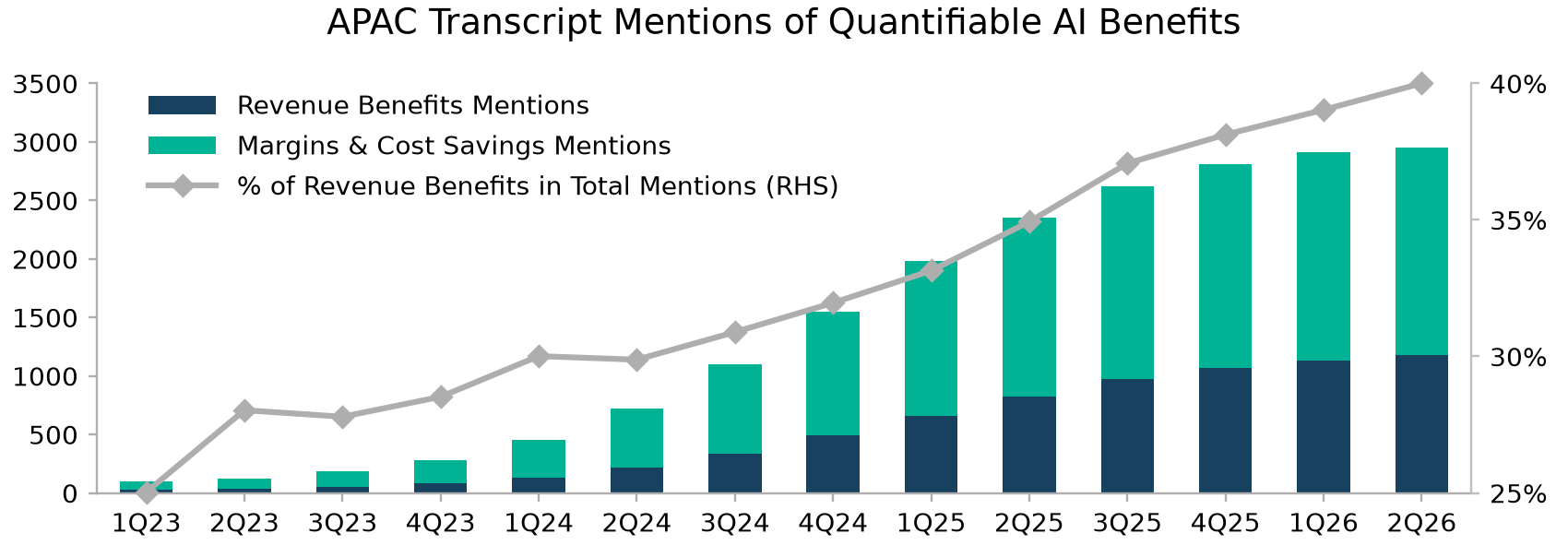
The forces working against the trade have less to do with demand than with the structure of the market. In a tighter liquidity environment, the balance sheets of certain companies are not as strong as the enthusiasm around them implies, and as more paper comes to market, a de-rating may follow. We estimate this new supply could approach USD 150 billion within a year (from the Anthropic IPO float plus SpaceX/Anthropic lockup expiries), arriving into portfolios that in many cases already carry between half and two-thirds of their weight in technology, and it is likely to act as a persistent weight on multiples for names that are already very well owned. Not to mention the frequent convertible offerings by the Taiwan technology companies to fund their capex and working capital needs. This is precisely what we are watching out for.
Execution from here is also going to be harder, simply because the capex numbers are now so much larger, and we think the market needs to bake in a higher cost of capital for the entire AI chain. As previously mentioned, we would not be surprised to see eventual capex land 20-30% below current expectations as regulatory and execution risks materialize. The regulatory backdrop has been calm so far, but our working assumption is that it will not stay that way, because no industry of this size has ever remained unregulated for long. The clearest catalyst on the horizon is the US mid-term elections, and were the outcome to shift in favor of the Democrats, we would expect a meaningful upturn in AI-related regulation and a potential slowing in the pace of data center rollouts.
Standing behind all of this is the question of interest rates and the credibility of the Federal Reserve under its new leadership. A good deal of attention has been consumed by the debate over whether the incoming chair will actually raise rates in September, but in our reading the rhetoric matters far less than the liquidity. The more telling signal sits on the balance sheet, where the recent operation twist looks to us like a form of de facto quantitative easing and yield control, and it is the balance sheet we would watch. A credible Fed is the good outcome here, because if the long bond runs away, the equity story will derail too. In a base case scenario, with tight global liquidity, businesses that generate strong free cash flow and return it to shareholders will outperform, a theme which we will return to later in our outlook below.
All of this leaves us with a deliberately balanced stance. We continue to hold roughly 35-40% of the portfolio in AI and technology, because it is a structural story we have no wish to sit out. However, we express it through names we believe will do well even if the pace of spending slows, and which should therefore not correct as sharply if sentiment turns.
Beyond technology, we are also watching developments in the Middle East closely. The conflict has so far unfolded against a backdrop of inventory drawdowns, which initially helped absorb disruptions while oil prices remained relatively contained. With inventories now lower and the Northern Hemisphere winter approaching, any further disruption to supply could produce a sharper response in crude prices and increase pressure on the parties involved to find a resolution. The path and timing remain uncertain, particularly given the political calendar, and markets may experience further near-term weakness as events develop. We would view any conflict-driven pullback as a potential opportunity to add selectively to high-conviction businesses where the underlying investment case remains intact.
Much of our recent internal discussion has centered on China, specifically why consumption has become so soft. Part of the answer is that the past data included substantial consumer subsidies, particularly around consumer durables, which pulled spending forward, and once that support is withdrawn, activity naturally slows. The more interesting part of the answer, though, is structural. Certain categories are simply maturing, and at the same time several unlisted players have executed extremely well and taken share from the listed incumbents. Douyin gaining ground on the established e-commerce platforms is the clearest example.
This dynamic is not unique to China, and we see a strikingly similar pattern in India, where a number of the older listed consumer names, businesses that have been public for a decade or more, are now growing more slowly than the market. In both cases, the common thread is that consumer tastes are changing, and the listed champions of the last cycle are not automatically the champions of the next. A good deal of our research effort is spent trying to establish where the new growth is accruing, and which of the new-age companies are capturing it.
Underlying all of this is a question of confidence, and the labor market sits at the heart of it. Wage growth has been held back in part by the automation of factory work and the increasing share of income earned through gig work. The country’s high headline savings rate reflects the balances of the wealthy far more than any broad-based sense of financial comfort. Prosperity, too, has been narrow, concentrated in a handful of successful companies, while even bright spots such as electric vehicles are now seeing competition erode their margins. Until confidence returns more broadly, we would expect the recovery in consumption to remain gradual.
We do expect some support to come through in time, even if it is not something we are relying on. As exports soften and normalize, the authorities have room for targeted consumption stimulus, and having already worked through durables, the next lever may well be housing or mortgages. Our base case allows for some measure of this, but we would far rather own the recovery through businesses that can compound regardless of whether it arrives.
The China story ties back to the cost of capital. Because the AI-exposed parts of the market are growing so much faster than everything else, companies are rushing to raise capital to fund the build-out. While appetite is strong, the recent Alibaba raise is one example. When capital was cheap, the steady issuance of new shares did little harm, but in a world where capital carries a real cost, investors are less willing to overlook the dilution and will pay lower multiples for companies that keep returning to the market. The reverse also holds: businesses that generate cash rather than consume it and return it to shareholders should be rewarded. Many of these stocks have gone nowhere on price yet still exhibit strong dividend yields, and as capital grows scarce, that income becomes more valuable and should support their share prices. This shapes our positioning in China. We pair the leading internet and cloud platforms, which we see as among the clearest beneficiaries of AI given their reach and the proprietary data they already own, with more defensive, cash-generative holdings in areas such as materials.
No market illustrates the current mood better than Korea. We have heard from a good number of investors who are hesitant to enter the Asian market precisely because they are worried about the volatility and the scale of the recent sell-off in Korea. In an environment where a great deal of trading is now done on the advice of AI, that kind of crowding and exuberance is usually the moment to take money off the table rather than to add to it, and that, in our reading, is where Korea has been.
The important point, though, is that the volatility reflects positioning rather than any deterioration in the businesses themselves. The fundamentals are strong and, if anything, improving, with the economy steadily decoupling from China and building out domestic capacity in defense, shipbuilding, power equipment, and semiconductors. The principal risk to that story is not company-specific but macro, namely a global recession that takes the whole cycle down with it.
Korea is in truth a specific instance of a more general principle that runs through the entire portfolio. Volatility is going to be structurally higher than investors have grown used to, and the only reliable way to manage it is through systematic diversification, both at the country/sector level and across individual positions. Our approach is to keep a reasonable and deliberate exposure to technology, because we know AI is a structural story, while accepting that we cannot know how the regulatory framework around it will evolve, and to balance that against non-technology opportunities where competitive intensity is lower and growth is reasonable within their relevant segments. In practice that means leaning on themes whose growth tracks are relatively independent of the AI hardware cycle, whether the consumer, defense, and industrial complex in Korea, pharmaceuticals in China, or the manufactured-export story in India, each of which provides a buffer and a hedge when technology corrects.
Beyond the near term, the case we would leave investors with is a structural one. Asia is simply no longer the asset class it was ten years ago. Its largest companies have moved from consuming cash to generating it, from ignoring minority shareholders to paying them, and from supplying components to owning technology that the rest of the world cannot easily replace. Most global portfolios, however, are still constructed as though none of that has happened, and it is that gap, between how the region has changed and how it is still owned, that we think defines the opportunity.
The United States now accounts for 63.6% of the MSCI ACWI against roughly 26% of global output, and its ten largest constituents, nine American companies plus Taiwan’s TSMC, make up close to a quarter of the entire index.2 For much of the past decade, that concentration rewarded investors, as asset-light American platforms came to dominate commerce and advertising. But benchmarks are backward-looking by construction, and we would rather allocate to where the index will be in ten years than to where it has been. The demands of the next two to three decades, building out AI infrastructure at scale, reindustrializing supply chains, electrifying transport, and hardening power grids, are physical, capital-intensive, and disproportionately met by Asia.
The balance sheets tell an equally striking story, and they are moving in opposite directions. The West is financing its build with borrowed money, with US federal debt having climbed from around 96% of GDP in 2010 to roughly 124% today and on a path toward 142% by 2031.3 Advanced-economy government debt is now close to 110% of GDP and corporates are also levering up in much the same way to fund AI infrastructure.4 Asia has spent the past decade doing precisely the opposite. Free cash flow (FCF) across Asia-Pacific ex-Japan is forecast to grow strongly this year and next, toward a record of around USD 1.4 trillion, and the region’s net debt-to-equity is set to fall from roughly 18% in 2023 to below zero by 2027.5 The market has not priced this in, with the region yielding 6.4% on FCF against 3.3% for developed markets, and every Asia-Pacific market bar Taiwan having a FCF yield more than the S&P 500. This is the cash-generative preference we referred to earlier, now visible across the whole region rather than in a handful of names.
Crucially, that cash is now reaching shareholders, and increasingly as a matter of policy rather than management preference. Governance standards across the region have tightened meaningfully, and the reforms feed on one another, with Japan’s pressure on companies trading below book value having set a template that Korea’s Value Up program has followed, while Shanghai, Hong Kong, and India have all tightened their listing and governance standards. Once one major exchange moves, the others face pressure to match it or risk losing capital to their neighbors, and that dynamic has turned capital returns into a durable, structural feature of the region rather than a periodic gesture.
Finally, and perhaps most importantly, Asia now owns businesses that the world cannot build without. Five years ago there were almost no trillion-dollar companies outside the United States, and today the region is home to TSMC at roughly two trillion dollars, Samsung above one trillion, and SK Hynix approaching a trillion, with a deep bench of strategically important businesses behind them. For a generation the argument for overweighting the US rested on the simple idea that the dominant global platforms were American and that you paid a premium for that dominance. That argument has eroded, because Asia now owns companies of equivalent strategic importance, and the market has not fully priced the fact, with TSMC trading on around 19x 2027 earnings and Samsung ~6x.
None of this requires a dramatic catalyst to matter. We have not yet seen capital allocated to emerging markets in any meaningful size, but as developed market yields tighten and the reflation runs its course, we think the flows will follow, because in a world full of challenges, the least challenged is likely to win. Money will leave the developed markets where financial repression bites first, and it will look for regions with stable regimes, without large structural imbalances, and without the heavy social obligations that weigh on so much of the developed world. On a five-year view, we believe that combination steadily raises the attractiveness of Asia relative to the United States and the rest of the developed world, and it is why, for all the near-term volatility, our conviction in the region has rarely been stronger.
For sophisticated investors only. For informational purposes only. The information presented in the material is not, and may not be relied on in any manner as legal, tax, investment, accounting or other advice or as an offer to sell or a solicitation of an offer to buy an interest in any investment product or any other entity sponsored or managed by Shikhara Investment Management. This material doesn’t constitute and should not be considered as any form of financial opinion or recommendation.
This material is prepared by Shikhara Investment Management LP (“Shikhara”). This material does not constitute an offer to sell or the solicitation of an offer to buy in any state of the United States or other U.S. or non-U.S. jurisdiction to any person to whom it is unlawful to make such offer or solicitation in such state or jurisdiction.
Investment involves risk. Past performance is not indicative of future performance. It cannot be guaranteed that the performance of the investment product will generate a return, and there may be circumstances where no return is generated. Investors could lose all or a substantial portion of any investment made. Before making any investment decision, investors should read the Private Placement Memorandum for details and the risk factors. Investors should ensure they fully understand the risks associated with the investment product and should also consider their own investment objective and risk tolerance level. Investors are advised to seek independent professional advice before making any investment.
Shikhara’s investment products are suitable only for sophisticated investors and require the financial ability and willingness to accept the high risks and lack of liquidity inherent in Shikhara’s investment products. Prospective investors must be prepared to bear such risks for an indefinite period of time. No assurance can be given that the investment objectives of any given investment product will be achieved or that investors will receive a return of their investment.
Certain of the information contained in this material are statements of future expectations and other forward-looking statements. Views, opinions, and estimates may change without notice and are based on a number of assumptions which may or may not eventuate or prove to be accurate. Actual results, performance or events may differ materially from those in such statements.
Certain information contained in this material is compiled from third-party sources. The information and any opinions contained in this document have been obtained from sources that Shikhara considers reliable, but Shikhara does not represent that such information and opinions are accurate or complete, and thus should not be relied upon as such. Furthermore, all opinions are current only as of the date of distribution and are subject to change without notice. Shikhara does not have any obligation to provide revised opinions in the event of changed circumstances. Whereas Shikhara has, to the best of its endeavor, ensured that such information is accurate, complete, and up-to-date, and has taken care in accurately reproducing the information, Shikhara takes no responsibility for the accidental publication of incorrect information, nor for investment decisions taken based on this material. Neither Shikhara nor any of its affiliates makes any representation or warranty, express or implied, as to the accuracy or completeness of the information contained herein, and nothing contained herein should be relied upon as a promise or representation as to past or future performance of any investment product or any other entity.
The MSCI AC Asia ex Japan Index captures large and mid-cap representation across Developed Markets (DM) countries (excluding Japan) and Emerging Markets (EM) countries in Asia. The index covers approximately 85% of the free float-adjusted market capitalization in each country. The MSCI China Index captures large and mid-cap representation across China A shares, H shares, B shares, Red chips, P chips, and foreign listings (e.g. ADRs). The index covers about 85% of the Chinese equity universe.
The contents of this material are prepared and maintained by Shikhara and have not been reviewed by the Securities and Exchange Commission of the United States.
The Shikhara logo and name are trademarks of Shikhara Investment Management LP, registered in Hong Kong, the People’s Republic of China (PRC), Australia, the United Kingdom, the European Union, and the United States.

This website is published exclusively for the purpose of providing general information about the management services carried out by Shikhara Investment Management LP, Shikhara Capital (Hong Kong) Private Limited and its affiliates (collectively “Shikhara Investment Management” or “Shikhara”). The information presented on the website is not, and may not be relied on in any manner as legal, tax, investment, accounting, or other advice or as an offer to sell or a solicitation of an offer to buy an interest in any investment product or any other entity sponsored or managed by Shikhara Investment Management. This website doesn’t constitute and should not be considered as any form of financial opinion or recommendation.
Shikhara Investment Management LP is a Registered Investment Adviser with the U.S. Securities and Exchange Commission, and Shikhara Capital (Hong Kong) Private Limited is licensed by the Hong Kong Securities and Futures Commission. This website does not constitute an offer to sell or the solicitation of an offer to buy in any state of the United States or other U.S. or non-U.S. jurisdiction to any person to whom it is unlawful to make such offer or solicitation in such state or jurisdiction.
Investment involves risk. Past performance is not indicative of future performance. It cannot be guaranteed that the performance of the investment product will generate a return and there may be circumstances where no return is generated. Investors could lose all or a substantial portion of any investment made. Before making any investment decision, investors should read the Prospectus for details and the risk factors. Investors should ensure they fully understand the risks associated with the investment product and should also consider their own investment objective and risk tolerance level. Investors are advised to seek independent professional advice before making any investment.
Shikhara’s investment products are suitable only for sophisticated investors and require the financial ability and willingness to accept the high risks and lack of liquidity inherent in Shikhara’s investment products. Prospective investors must be prepared to bear such risks for an indefinite period of time. No assurance can be given that the investment objectives of any given investment product will be achieved or that investors will receive a return of their investment.
Certain of the information contained in this website are statements of future expectations and other forward-looking statements. Views, opinions, and estimates may change without notice and are based on a number of assumptions which may or may not eventuate or prove to be accurate. Actual results, performance, or events may differ materially from those in such statements.
Certain information contained in this website is compiled from third-party sources. Whereas Shikhara Investment Management has, to the best of its endeavor, ensured that such information is accurate, complete, and up-to-date, and has taken care in accurately reproducing the information, Shikhara Investment Management takes no responsibility for the accidental publication of incorrect information, nor for investment decisions taken based on this website. Neither Shikhara Investment Management nor any of its affiliates makes any representation or warranty, express or implied, as to the accuracy or completeness of the information contained herein, and nothing contained herein should be relied upon as a promise or representation as to past or future performance of any investment product or any other entity.
The contents of this website are prepared and maintained by Shikhara Investment Management and has not been reviewed by the Securities and Exchange Commission of the United States or the Securities and Futures Commission of Hong Kong.
The Shikhara logo and name are trademarks of Shikhara Investment Management LP, registered in Hong Kong, the People’s Republic of China (PRC), Australia, the United Kingdom, the European Union, and the United States.